

Every school has one: the student who always seems to plan ahead, never melts down, and somehow remembers every deadline. They look magical from the outside.
But the truth is simpler, and far more encouraging. That student isn’t a productivity unicorn. They’ve built a few structures that make chaos manageable. Those structures all live under one umbrella called executive function.
Executive function isn’t a personality trait; it’s a set of learnable skills for organizing, prioritizing, and following through. Anyone can practice them.
The big misunderstanding is that success in school requires being “perfect.” It doesn’t. What you need is a minimum viable system—small, repeatable habits that keep you 80% organized 80% of the time. That’s enough to transform panic into progress, and progress into a reputation for excellence.
Executive function is a loser’s game
High-school executive function works more like amateur tennis (a “loser’s game”) than professional tennis (a “winner’s game”). In a winner’s game like pro tennis, you win by hitting brilliant shots. In a loser’s game like amateur tennis, you win by making fewer unforced errors.
Students don’t need flawless color-coded calendars and hour-by-hour life plans. At this level, that’s completely unnecessary (though often pretty!) They need to avoid the common traps: missing deadlines, losing track of assignments, and realizing at 11 p.m. that something’s due tomorrow.
When you aim for “fewer unforced errors,” the work shifts from perfectionism to prevention. That’s when prioritization tools start to make sense. They stop being self-help jargon and start being practical. Consistency matters more than intensity. An 80% reliable routine beats a perfect-seeming system that’s abandoned after a week. The students who succeed aren’t better; rather, they’ve just built routines sturdy enough to survive a bad Tuesday.
Realism and judgment-free honesty
The work habits of high schoolers were formed in middle school. Those middle school habits usually break down somewhere around Geometry or Algebra 2. Suddenly, “I get it in class” no longer means “I can do it alone.” It might be the first time a student needs to put in “real” work. When students reach high school, the expectations jump quickly, and so does the need for structure.
Here’s the moment that matters: when students realize their current method isn’t working. Some (many!) students cover their eyes and naively hope the problem will go away. Some interpret that realization as failure—“I’m just bad at this.” But noticing a broken system is actually a win: after all, you can’t fix what you don’t see.
The high-school superstars have learned to treat grades as feedback, not verdicts. A disappointing test doesn’t mean you’re incapable; it means your process needs improvement. This is an extremely difficult mindset to adopt in today’s go-go grades-first environment, but it’s necessary for continued success.
If you keep forgetting to open your paper planner, it’s not a moral flaw. It’s data. Maybe you need a hybrid—Google Calendar for visibility, plus a short daily to-do list you can check from your phone. Learning is trial and error. Successful structure is, too.
Prioritizing with the Eisenhower Matrix
To be able to manage your work, you have to be able to triage it. Enter the Eisenhower Matrix—a deceptively simple tool that helps explain why some students stay calm while others flail.
Four boxes, two questions: Is it urgent? Is it important?
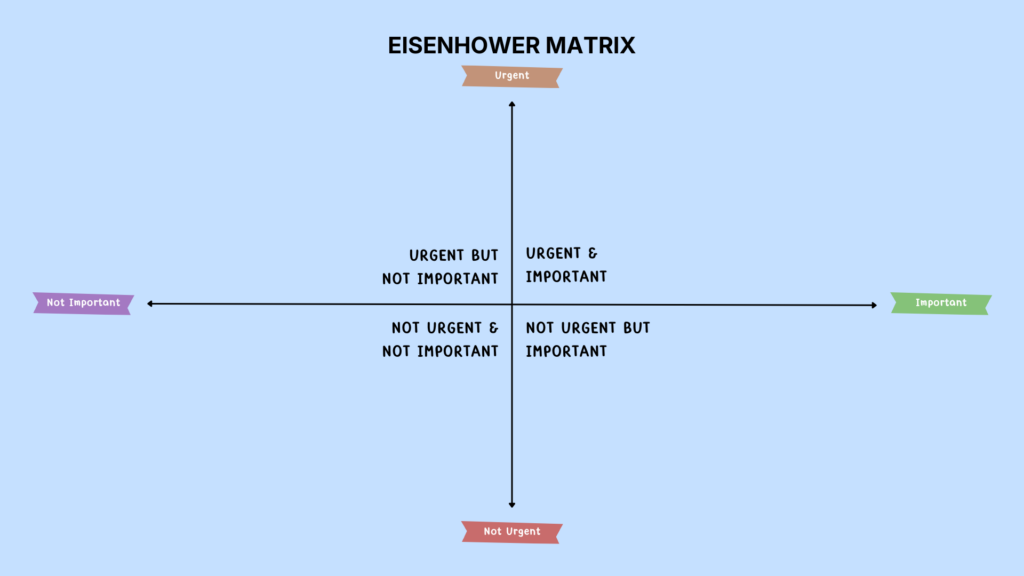
- Urgent & Important (U/I): Do it now. Today’s test, tomorrow’s project. Use your best energy here.
- Not Urgent, but Important (NU/I): Next week’s test, a paper due in ten days. Touch it today for 20 minutes. That tiny head start prevents 90% of stress.
- Urgent, but Not Important (U/NI): Busywork. Do it later in the session and stop at “good enough.”
- Not Urgent & Not Important (NU/NI): Optional. Do it if there’s time; otherwise, park it.
Rule of thumb: protect NU/I time every school day. It’s where growth happens …and panic doesn’t.
The matrix only works if you use it to choose, not just to label. A 10-minute decision each afternoon—“What belongs where?”—can replace hours of indecision later.
See around corners
Most school stress doesn’t come from workload; it comes from surprise.
When everything feels urgent, it’s usually because the important stuff wasn’t mapped early enough. Structured thinkers “future-proof” their semester so urgent stops ambushing important. And the ability to break down tasks into manageable chunks makes it clear what it actually means to “study.”
Here’s how to start:
- Find the syllabus. If none exists, ask teachers for major dates.
- Add all tests and projects to a real calendar. Paper is fine; digital is better if you’ll actually check it (because you can set reminders!).
- Estimate lead times. Example: “Start history review 7 days before test.”
- Be extremely specific. Even better: “On Monday, read history textbook pages 282-301 and write key events+dates on flashcards.”
- Spot collisions. Notice when two big deadlines or exams overlap. Decide now—can you prep both, or should one move? Can you get ahead of one deadline to make the other more manageable?
The goal isn’t perfect prediction. It’s creating known unknowns—foreseeable challenges that won’t blindside you later.As one of my students put it: “When I can see the wave coming, I can surf it. When I can’t, it just hits me.”
Structured thinking = task breakdown + backward planning
You might be thinking, “Wes, I’ve tried starting early before and I still seem to flounder.” Here’s why simply “starting your paper early” rarely works: big, looming tasks feel like fog. The brain resists what it can’t visualize.
To make a big project manageable, you translate it into steps and mini-outcomes. Then you place them backward from the due date.
Example: Instead of “Write history paper,” think:
- Choose topic → gather sources → outline → ugly draft → revise → proofread → submit.
You’re not chasing a finish line; you’re laying stepping stones.
Keep steps small enough to complete in one sitting—20 to 45 minutes. Small steps create traction. Big vague goals create stress and guilt. When students sit down the night before the paper’s due and write for 3 hours straight, they’re making it harder than it needs to be.
When you plan backward, you replace “I hope it gets done” with “I know what to do next.” That’s structured thinking in action.
Worked examples you can copy
A. History research paper (7-day arc)
Day 1 (the day it’s assigned): Read the prompt carefully. Write down clarifying questions.
Day 2: Skim sources. Take rough notes and note early ideas.
Day 3: Pull key quotes and group them by theme. Draft a basic outline.
Day 4: Turn bullet points into sentences—ugly draft on purpose.
Day 5: Read it as your teacher will. Fix weak logic or missing evidence.
Day 6: Line-edit and polish.
Day 7: Proof once, then submit and rest.
B. Math unit test (7-day arc)
Day 1 (the day the test is announced): List topics; rank weak → strong.
Days 2–4: Patch gaps with notes, videos, or teacher help.
Days 5–6: Active practice under mild time pressure. Mark and redo misses.
Day 7: Warm-up on a few problems. Go rock the test.
Each step is short enough to finish, specific enough to repeat.
The Minimum Viable System (MVS)
Forget the 17-tab spreadsheet. A simple, functional system fits in your backpack and your brain.
Your MVS checklist:
- One calendar: all tests, deadlines, and commitments.
- One task list: Eisenhower tags (U/I, NU/I, U/NI, NU/NI).
- One weekly review (15–20 minutes, perhaps on Sunday): look ahead 14 days, predict deadlines and overlapping assignments, schedule NU/I blocks to chip away at big tasks.
- One daily check-in (2 minutes after school): add new items, pick tomorrow’s top three.
That’s it. Small enough to maintain, strong enough to prevent disaster.
Consistent 80% execution beats beautiful but abandoned plans.
Where coaching helps (and when to DIY)
If systems keep breaking, the culprit usually isn’t willpower—it’s friction. Wrong tools, unclear goals, or no one to help debug the process.
A good coach helps students identify those friction points, test fixes, and stay judgment-free while habits form.
Free 30-minute parent consult
Not sure where to start?
Tell us what’s going on with your student and we’ll point you to the right next step. No prep, no pressure.
Book your free consult →

0 Comments